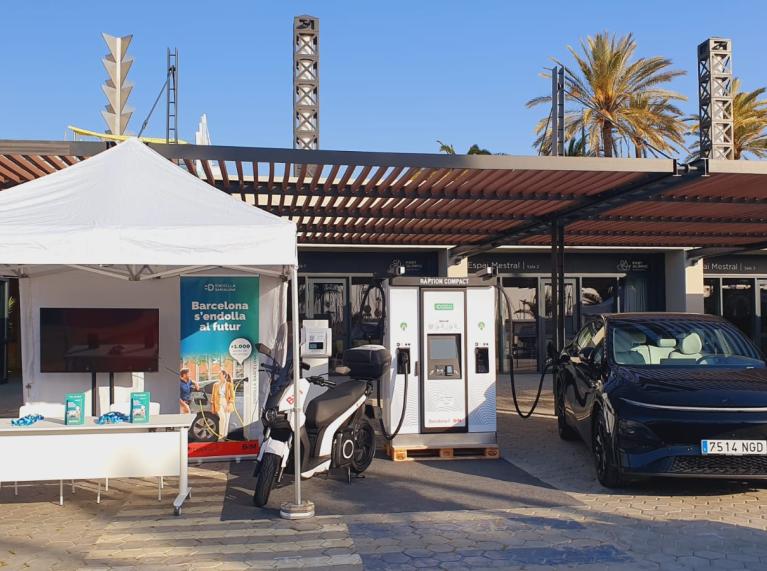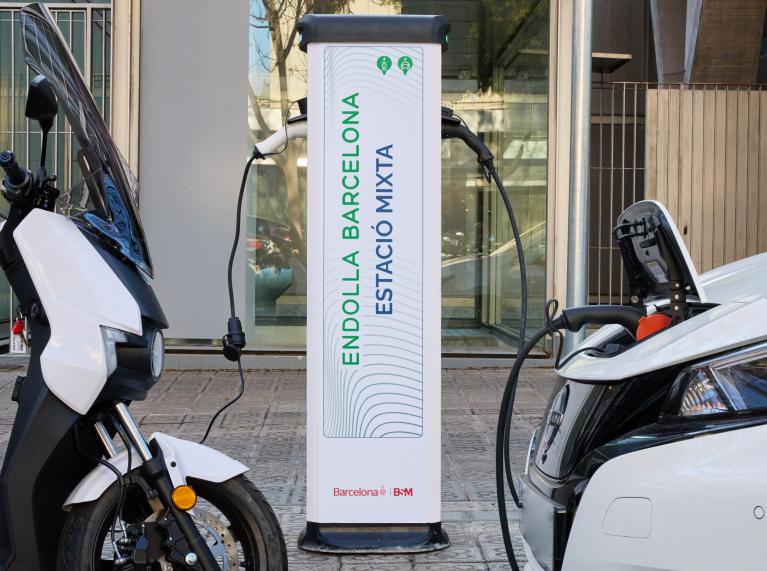
Endolla Barcelona is testing a charging point that’s cost-effective to produce and easy to maintain. This is one of the projects resulting from a call made two years ago by Ajuntament de Barcelona and Barcelona de Serveis Municipals (BSM) through the InnovAcció 2030 programme to address some of the challenges of expanding electromobility in the city.
The charging point being tested has been designed to allow for cost-effective mass production and easy maintenance. The aim is to address the sector’s challenge of creating charging infrastructure that is easy to manufacture and user-friendly, thereby supporting the rapid expansion of electric vehicles in the city.
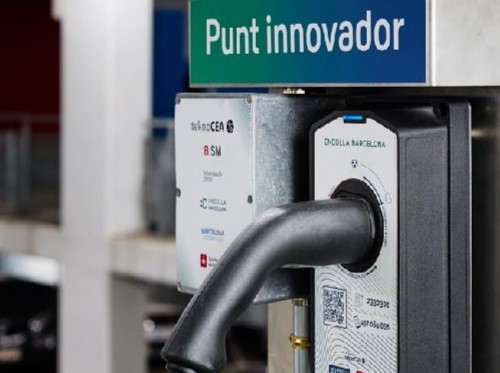
The prototype, still in the testing phase at the BSM Plaça Navas car park, was developed by teknoCEA, a Catalan spin-off company from the Universitat Politècnica de Catalunya - BarcelonaTech (UPC), which provides electrical energy solutions. It costs 80% less than existing charging points.
- Revolutionary design: a disruptive electromechanical design that enables cost-effective mass production.
- All-in-one: a single unit includes all the necessary components for charging (RFID, energy meter, MID, RDC 6mA differential current sensor, RGB LED indicator, and a 16 x 2 character LCD display).
- Easy installation: simple wiring management and space for protective measures in accordance with the electrical regulations of each country.
- User-friendly plug: allows for one-handed connection and features a motorised shutter and a locking device, in compliance with EU safety regulations.
- Wireless connectivity: includes a wireless network that connects the charging points to an OCPP gateway.
Evolution and innovation in communications
This innovative project features a pioneering mesh wireless network comprised of all the charging points and at least one gateway. When the range of a transmitting node is insufficient to reach the destination node, the charging points also function as repeaters, extending the message’s reach throughout the entire facility. The gateway monitors all the charging points in the network and includes an OCPP 1.6J client to interact with the backend. All exchanged information is encrypted and protected against cyberattacks. This solution eliminates the need for communication wiring, thereby simplifying the setup and reducing investment costs.

Advanced setup to reduce costs
The electromechanical design minimises human intervention to reduce costs and improve production quality, through the use of conductors integrated into a printed circuit board instead of manually installed internal wires. The design also consolidates all necessary components into a single point and a single printed circuit board unit. The result is a charging point with a simplified structure that can be manufactured on an automated production line.